 Cruise to St Lucia
Sulphur Springs: Saint Lucia's Drive-In Volcano
Sulphur Springs - St Lucia's drive-in volcano, to give the billing its full swagger - is the reason the word 'unique' survives in the island's tourism vocabulary: a live geothermal field you can drive into, walk across the crater floor of, and coat yourself in its mineral mud, all within a few hundred metres of Soufriere town. It is the most visited paid attraction on the island - roughly 200,000 people a year - and the centrepiece of nearly every land excursion sold at the cruise port. This guide covers what it actually is, what the mud bath feels like, what entry costs, and how it fits a port day. Every stop named here is priced in the St Lucia shore excursions compared on this site.
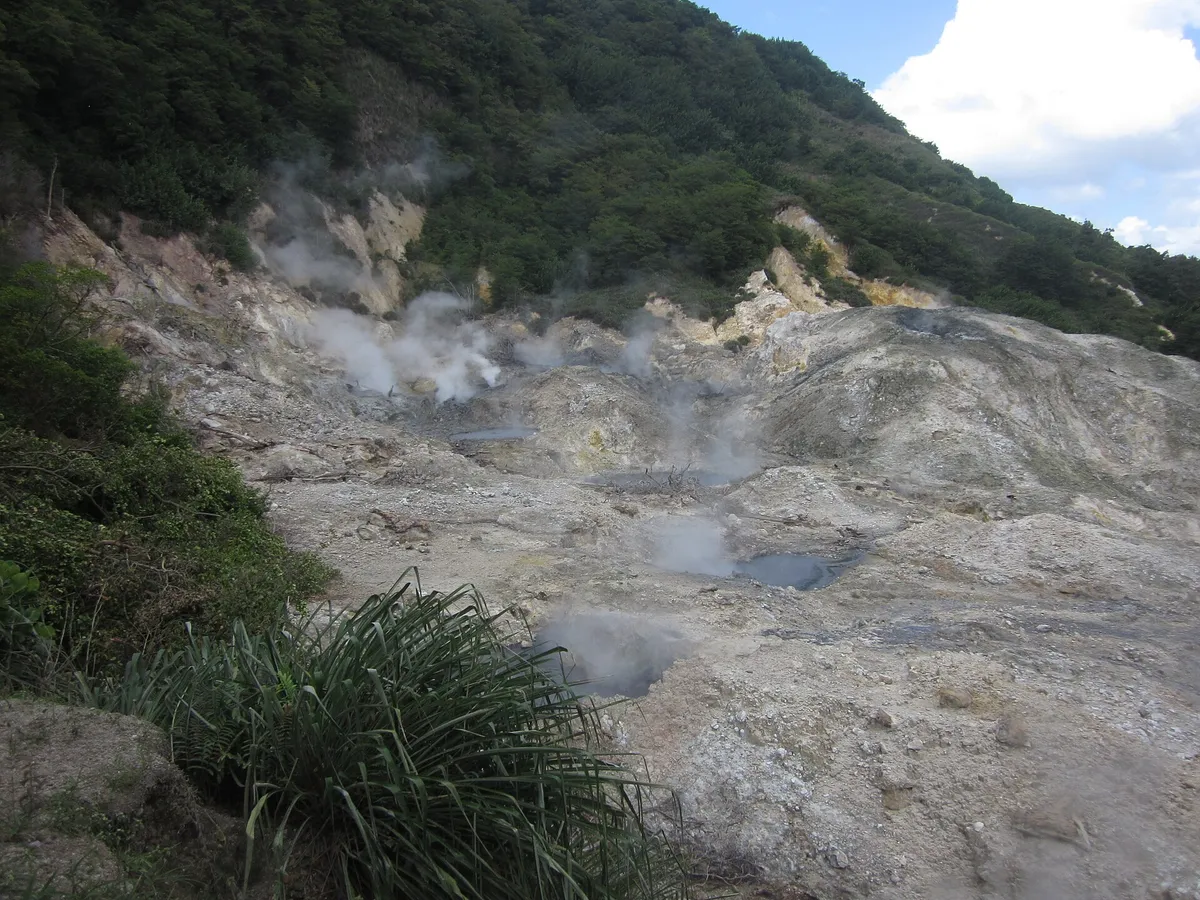
Steam plumes on the crater floor at Sulphur Springs - the springs at the field's centre run at boiling point. Photo: Sfearion, Wikimedia Commons, CC BY 4.0.
Quick answer What the drive-in volcano is, what the mud bath costs, and the one colour of swimwear to pack
Sulphur Springs is a geothermal field inside the collapsed caldera of a volcano that last erupted in the late 1700s - dormant, but boiling: spring water at its centre runs at about 100°C, black with sulphur and iron. The visit has two halves: a guided walk past fumaroles and boiling mud pits, and the mud bath itself, where the water has cooled to a bathable ~45°C (110°F) a few hundred yards downstream. Walk-in entry runs about US$10 for the bath experience, paid to the park's managing foundation; nearly every cruise visitor arrives on a tour that bundles transport, entry and usually a waterfall stop - the mud bath and waterfall tour in our comparison is the pattern listing. Wear a dark swimsuit: the mineral mud stains light fabric permanently.
Key takeaways
- Booking the trip? See how the Soufriere listings compare on entry fees, time at the Springs and what lunch costs extra
- The smell is the show: what the volcano facts below explain about the caldera you are standing in
- Pairing it right: the Toraille waterfall sits on the same loop and most tours chain the two
What Sulphur Springs Actually Is
Drive south-west from Castries and the island folds into green ridges that eventually open around Soufriere town - a French-named harbour town whose name translates, accurately, as sulphur mine. Seven miles of winding road beyond the town's edge, the ground starts steaming.
Sulphur Springs sits inside what is left of a volcanic caldera - the collapsed crater of a system whose last eruption, local geologists place in the late 1700s. It is classified dormant, meaning no magma movement, but nothing about it is cold: dozens of fumaroles vent steam that is visible for miles, mud pots bubble at the consistency of warm porridge, and the springs at the field's centre run at full boil, around 100°C. The water's near-black colour is chemistry, not dirt - a reaction between high sulphur content and iron, with deposits of copper, iron oxide and calcium oxide lining the channels.
The park's billing - the world's only drive-in volcano - is honest: a paved road descends onto the crater floor itself, and the viewing walk happens inside the caldera rather than on its rim. No other site in the Caribbean lets you do that.
Reading the Crater: What You Are Looking At
The standard visit runs about 45 minutes to an hour with a park guide who walks the group along the fenced viewing line. The stops worth attention: the boiling springs at the centre, where the water surface trembles and steam columns rise off the hillside; the mud pots, grey and quietly percolating, which are the same mineral mixture visitors later sit in at bathable temperature; and the fumarole vents along the ridge, where the hiss is audible and the ground is warm through footwear soles.
The smell is the first thing everyone mentions - a sharp sulphur tang, strongest near the vents, entirely harmless at the concentrations visitors meet, and forgotten within minutes. Photographers get the best frames late morning, when the sun has burned off the early mist but the steam columns still catch light; after heavy rain the whole field runs steamier.
Geology in one sentence for the guides' standard explanation: this is what the island looks like before it stops being volcanic - the caldera collapsed inward, the heat source is retreating, and what remains is a slowly cooling kettle that happens to be the Caribbean's most accessible piece of live volcano.
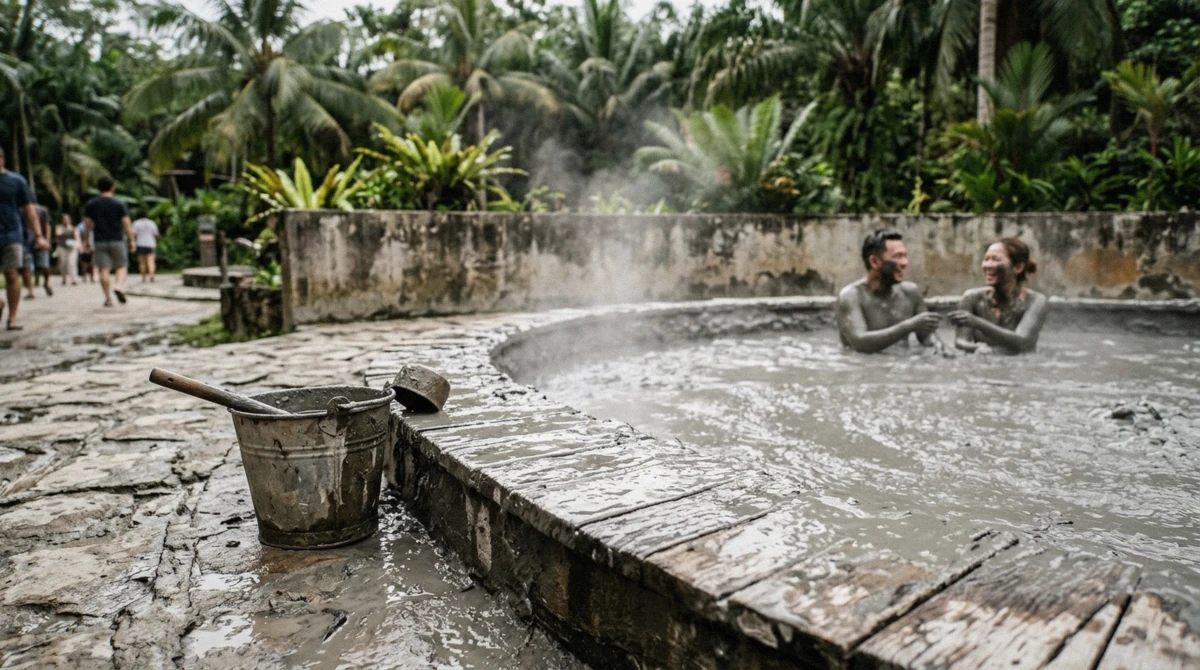
The mud bath: the same sulphur-iron mineral mix seen boiling at the centre of the field, cooled to a bathable 45°C downstream. Editorial illustration generated for this guide.
The Mud Bath: What Actually Happens
A few hundred yards downstream from the boiling centre, the spring water has cooled to around 45°C (110°F) - hot-tub temperature rather than kettle - and pools there hold the famous mud. The routine is communal and cheerful rather than spa-serious: an attendant ladles the wet mineral mud over you - traditionally applied by hand or straight from the bucket - you rub it in until skin is uniformly grey, let it dry to a cracking mask for ten minutes or so while the warmth soaks in, then wash it off under showers or in the rinsing pool, emerging, by consensus, with remarkably soft skin.
The therapeutic claims - detoxifying, easing sunburn, eczema, aching joints - are what the park and two centuries of visitors say of it; medicine remains politely non-committal. What is verifiable: the water holds the same sulphur-iron-calcium mineral profile as the springs above, the warmth is real geothermal heat rather than piped-in, and the skin-smoothing effect is unanimous in review after review.
The practical brief: dark swimwear (the mud permanently greys light fabric), sandals that grip wet stone, a towel from the bus, and no jewellery - the minerals dull silver. Pools can feel scalding in spots at first entry; ease in standing until your skin settles. Changing rooms, restrooms and outdoor showers sit beside the pools, and lockers are available for the dry bag.
Entrance Fees, and the 2025 Increase That Was Paused
The park is managed by the Soufrière Regional Development Foundation (SRDF), the local non-profit that runs Sulphur Springs for the community, and its published walk-in rates have sat for years around US$10 for the mud bath experience for visitors, with a guided volcano-tour option slightly cheaper and a combination ticket covering both. Children pay roughly half. The SRDF sells tickets at the gate and through its own site, and walk-ins need no reservation - you pay, you are assigned to the next guide rotation, you bathe.
One date matters for anyone quoting prices: in mid-2025 the SRDF announced a fee increase - the visitor mud bath moving to around US$12 (XCD 30) - and then paused it days later after public and operator backlash, keeping the existing rates pending review. The honest position for 2026 travellers: budget the classic US$10, expect the US$12 to return at some point, and read every bundled tour's fine print to see whether entry is inside the price or an add-on at the gate.
Every listing in our excursion comparison states its entry-inclusion status plainly - it is the single most common source of small-print surprise on this attraction.
What Entry Costs at the Gate
Walk-in rates as published by the park's managing foundation, with the paused-2025 figures marked. Cruise visitors on tours should compare against their listing's inclusion line before paying twice.
| Experience | Walk-in rate | Notes |
|---|---|---|
| Mud bath experience | About US$10 adult / US$5 child | Includes the crater walk and the bath; was set to rise to about US$12 in 2025 - increase paused |
| Guided volcano tour (walk only, no bath) | About US$9-10 adult | The crater-floor guided walk without bathing |
| Combination (tour + bath) | About US$15 adult | The standard walk-in bundle |
| Tours from the cruise port | About US$85-210 per person | Transport plus entry plus a waterfall or beach stop - see the homepage comparison for what each price covers |
Getting There From the Cruise Port
Sulphur Springs sits in the hills above Soufriere, roughly an hour and a half's drive from the cruise terminals along the island's winding west-coast road - the drive itself is half the sightseeing, past fishing villages, banana country and the hairpin above Anse La Raye where the whole coastline opens below.
Three realistic routes exist on a port day. The road tour - van or minibus with a driver-guide - chains the Springs with a waterfall, a viewpoint stop and often a plantation lunch. The catamaran sails to Soufriere and busses up the short remaining distance, trading road hours for deck hours. The speedboat does the same faster, landing at Soufriere's jetty where water taxis complete the hop; the fastest listings reach the mud by mid-morning and hold the road bill to under two hours total.
What does not work: independent taxis arranged ad hoc for the round trip usually cost more than a packaged tour on this route, and public buses - while genuinely cheap - run on town-to-town schedules that no eight-hour port call should gamble on. This is the one headline attraction where booking beats improvising; the comparison table shows the trade-offs side by side.
What Pairs With the Springs on the Same Loop
The Springs sit inside a cluster of sights no more than fifteen minutes apart, which is why every Soufriere tour is a combination. The classic partners:
Toraille Waterfall - a 15-metre (50 ft) curtain of water dropping into a garden pool on the edge of Soufriere, open to swimmers on days the flow allows; the standard cool-down after the warm mud.
Diamond Botanical Gardens and Waterfall - the oldest botanical grounds on the island, where mineral streams run the colour of the rock they cross and the Diamond Falls themselves change hue after heavy rain.
The Pitons viewpoints - Gros and Petit Piton announce themselves from the Soufriere road long before you reach the Springs, and most tours build a photo stop at the classic angle above Soufriere Bay.
Sugar Beach - the white-sand bay wedged directly between the two Pitons, where the post-Springs swim becomes the day's second act for the catamaran and speedboat listings.
Morne Coubaril and plantation estates - the working-horse, cocoa-and-coconut estate stops that chain a zipline, a creole buffet or a chocolate demonstration onto the same half-day.
Which combination fits your port hours is arithmetic: the pairings and durations in the homepage comparison state each listing's stops against its total runtime, and the hour-by-hour port-day breakdown shows where the road bill lands.
The Practical Brief
Timing. The Springs run daily through the daytime hours; cruise-day mornings bring the tour convoys and the pools fill with grey bodies from about 10:30 - early boats reach the mud first. An hour on site covers the crater walk and a proper unhurried bath.
What to bring. Dark swimwear, a change of clothes, a towel, sandals, and a dry bag or zip pouch for phones - the steam and the mud are both hostile to electronics. Jewellery stays on the bus.
Who it rules out. The heat rules in caution for anyone with high blood pressure or pregnancy in the later stages - the pools run hot and the walk is short but sun-exposed. Children bathe happily at the pool edges; the boiling sections are fenced and the guide line is firm.
The honest caveats. The smell clings to hair until the next shampoo. The changing rooms are functional, not plush. And on cruise days the crowd clock is real: two buses at once means a busy pool - one more reason the early-morning listings earn their premium in the comparison.
The verdict in one line: no other stop on the island packs this much story - geology, medicine, folklore, a soak - into an hour, which is why every route in the comparison crosses it and why the visit repays the guide's worst joke. The crater has heard them all; the mud outlasts them.
A Short History of the Field
The springs named the town before either had tourists: Soufriere - the French for sulphur mine - was on the maps while the caldera's vents were still being argued over by the navies that fought for this coastline. The 18th century ran the failed experiment the name records: attempts to mine the sulphur commercially collapsed under the reality of the terrain, leaving the name and the story but little else.
The field's modern fame arrived by eruption, or rather by the record of one: the 1766 eruption - the event local memory compresses to 'the 1700s' - threw the caldera back into the colonial record, and the springs' reputation as medicine followed the planters' guests soon after. The baths as an institution built through the 19th and 20th centuries: the pools cut where the spring water cools to bathable, the Changing Rooms era, the guides' profession formalised.
The modern chapter belongs to the Soufriere Regional Development Foundation, the community trust that has run the park since the state handed it over - the body whose gate fees fund the town's projects, whose 2025 fee-rise attempt made national news for being paused, and whose signage still bills the field with the only marketing line it has ever needed: the world's only drive-in volcano. The fees table on the homepage prices the visit; this paragraph is what the ticket is a share of.
The Science, Without the Lesson Plan
What is actually happening under the crater floor is a story of leftovers. The volcanic system that built this coast is not dead - it is cooling, and the rainwater seeping down through the fractured rock meets rock still hot enough to boil it. The superheated water returns through the fissures as the steam columns and boiling springs the crater walk passes, picking up the chemistry that gives the field its colour and its fame: sulphur and iron from the rock, reacting to the near-black of the central pools; calcium, copper and iron oxide in the deposits the water leaves like scale.
The mud bath's magic number is distance: a few hundred yards from the boiling centre, the same water arrives at ~45°C (110°F) - too hot for a long soak, perfect for the mineral soup the pools hold, and the reason the baths sit where they sit. The mud itself is that water mixed with the fine volcanic clay the field grinds continuously - the same grey mixture, cooled and stirred, that the attendants ladle on by the bucket.
And the therapeutic claim, handled honestly: the minerals are real, the warmth is real, the soft-skin consensus is real, and medicine's formal endorsement remains pending - eczema and sunburn relief are reported widely enough that the park prints them, and the controlled studies remain thinner than the testimonials. The honest posture is the field's own: come for the geology, stay for the skin, believe what your arms tell you.
Sulphur Springs: Questions Before You Soak
What is the entrance fee for Sulphur Springs in Saint Lucia?
Walk-in rates from the park's managing foundation sit around US$10 for the adult mud bath experience, about US$9-10 for the guided crater walk without bathing, and about US$15 for the combination - children roughly half price. A 2025 increase to around US$12 was announced and paused after backlash, so budget the classic rates but expect movement.
Is the mud bath actually good for your skin?
Visitors and the park credit it with easing sunburn, eczema and aching joints; medical science stays non-committal. What is certain is the mineral profile - sulphur, iron, calcium oxides in the water - and the near-universal review consensus on softer skin afterwards.
Can you visit Sulphur Springs without a tour?
Yes - the park welcomes walk-ins who pay at the gate and join the next guide rotation. The catch on a port day is the drive: an hour and a half each way from Castries means independent taxis typically cost more than a packaged tour once round-trip fares and waiting time are counted.
How hot is the water in the mud baths?
The bathing pools run around 45°C (110°F) - hot-tub hot - fed by spring water that boils at roughly 100°C at the centre of the field a few hundred yards upstream. Ease in standing first; some spots run hotter than others.
What should I wear and bring to Sulphur Springs?
A dark swimsuit - the mineral mud permanently stains light fabric - plus sandals, a towel, a change of clothes and a dry pouch for your phone. Leave jewellery behind; the minerals dull silver. Changing rooms and showers sit beside the pools.
How much time does a Sulphur Springs visit take?
An hour on site covers the guided crater walk and a proper soak; the tours sold at the cruise port run three to eight hours total because the drive from Castries adds about three hours round trip and most listings chain a waterfall, viewpoint or beach stop onto the loop.
Can you visit Sulphur Springs on a rainy port day?
It is the island's best rainy-day destination: the crater walk is short and paved, the baths are warm in the rain by definition, and the steam reads twice as dramatic in wet air. The drive still runs in all but storm conditions - and on the greyest Castries morning, the mud bath tours are the listings most likely to have been the right call.